No radar human-activity-recognition dataset is best for every project. The right choice is the dataset whose radar representation, activity labels, participants, environments, and evaluation groups match the claim you want to make. A large point-cloud dataset cannot answer a question about ADC-level processing, and thousands of overlapping windows do not create thousands of independent human motions.
For a first point-cloud classifier, RadHAR is approachable. For complex FMCW measurements and assisted-living activities, the University of Glasgow’s Radar Signatures of Human Activities is unusually useful. Choose CI4R-MULTI3 for cross-frequency experiments, OPERAnet for synchronized RF modalities and continuous activities, MM-Fi for multimodal pose and action research, and the 2026 Spatial Millimetre-Wave Radar Point Cloud Dataset for controlled rehabilitation movements with aligned skeleton labels.
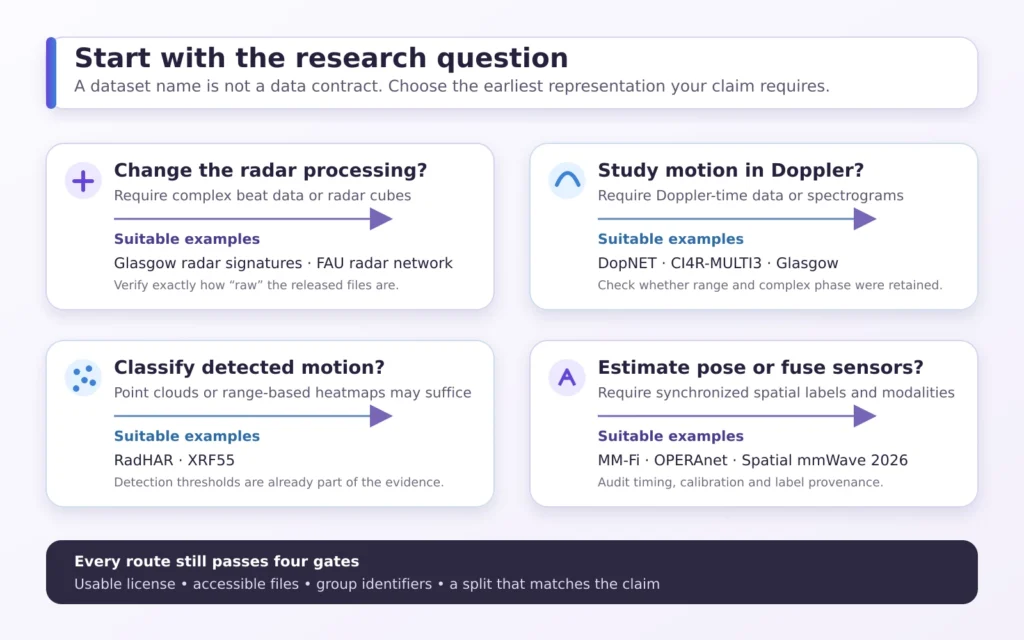
Short answer: choose the research claim first, then reject every dataset that lacks the required signal level, labels, grouping identifiers, usable licence, or accessible files. Compare the survivors by independent participants and conditions—not by the largest tensor dimension.
Access, documentation, and licence notes in this guide were checked on 12 September 2026. Repository links and download terms can change, so verify them again before committing a project.
The fastest way to choose
| Research goal | Strong starting choice | Why | Important boundary |
|---|---|---|---|
| Learn a point-cloud HAR pipeline | RadHAR | Small activity vocabulary, public data, preprocessing code, and published baselines | Detected points are not raw ADC data; confirm what the supplied split actually tests |
| Develop FMCW or micro-Doppler processing for daily activities and falls | Glasgow Radar Signatures | Complex beat-note sequences, multiple collection campaigns, and substantial participant diversity | Activity availability and cohort composition differ across campaigns |
| Test transfer across radar frequencies and waveforms | CI4R-MULTI3 | Synchronized 10, 24, and 77 GHz measurements of the same activity vocabulary | Only six participants and line-of-sight performances |
| Study synchronized RF sensing, continuous actions, or localization | OPERAnet | Wi-Fi CSI, passive Wi-Fi radar, UWB, and Kinect across two rooms | It is not a conventional active mmWave point-cloud dataset |
| Study pose, action recognition, or multimodal learning | MM-Fi | Five synchronized modalities, 27 actions, 40 people, and pose annotations | The mmWave release is processed point-cloud data, and the licence is non-commercial |
| Study a broad indoor action vocabulary | XRF55 | 55 classes, 39 people, four scenes, and synchronized RF and vision modalities | Audit current file availability and reuse terms before designing around it |
| Study controlled health or rehabilitation movements with skeleton supervision | Spatial mmWave 2026 | 21 movements, 26 adults, radar point clouds, and aligned 32-joint skeletons | Healthy adults in a controlled room do not establish clinical deployment performance |
| Study multistatic radar cubes or fall detection | FAU radar-network dataset | Two four-dimensional radar cubes per measurement from 15 participants | Large download and non-commercial licence |
If you have not yet fixed the task, representation, and evaluation claim, begin with our broader guide to radar-based human activity recognition. If you already have raw recordings, the companion workflow from ADC samples to activity labels explains where each representation enters the processing chain.
A dataset chooses part of your method for you
Radar datasets differ at a more fundamental level than image datasets that all provide pixels. One release may contain complex samples close to the receiver output, another may contain range–Doppler heatmaps, and another may contain only detections produced by a proprietary or fixed signal-processing chain. Those are different experimental starting points.
| Released representation | What you can change | What is already fixed or discarded | Typical research question |
|---|---|---|---|
| Complex ADC or beat-note data | Calibration, clutter suppression, range/Doppler processing, detection, representation | Only decisions made in acquisition and hardware | Does a new radar-processing method improve HAR? |
| Radar cube or range–Doppler/angle maps | Some calibration, gating, temporal representation, learning model | Earlier decoding and transforms may already be fixed | Which spatiotemporal representation works best? |
| Micro-Doppler or Doppler–time data | Time–frequency features, normalization, temporal model | Range selection, clutter removal, and often STFT settings | Can motion dynamics distinguish the activities? |
| Detected point clouds | Point aggregation, tracking, voxelization, graph or point model | Thresholding and embedded detection have removed subthreshold returns | Can sparse spatial motion support classification or pose? |
If your contribution changes the range FFT, clutter filter, micro-Doppler extraction, CFAR detector, or angle estimator, a point-cloud-only release is a hard mismatch. Conversely, if your aim is an efficient point-network architecture, downloading terabytes of raw samples may add cost without adding evidence. Our explanation of range–Doppler–angle processing shows exactly which information exists at each stage.
Eight radar-HAR datasets compared
The table below uses source-reported counts. They describe different units—files, windows, frames, sequences, or trials—so they must not be read as a leaderboard.
| Dataset | Radar and released form | People and task scale | Environment or view |
|---|---|---|---|
| Glasgow Radar Signatures | 5.8 GHz FMCW; complex beat-note sequences | 99 volunteers reported in the associated study; five daily activities, with falls in selected controlled campaigns | Laboratory, university common room, housing facilities, and an Age UK centre across several campaigns |
| RadHAR | TI mmWave detected point clouds and derived voxel sequences | Five activities; 71.6 min training and 21.4 min testing; 15,635 overlapping derived windows | Controlled collection; participant/session diversity is not prominent in the repository documentation |
| DopNET | 24 GHz FMCW; preprocessed complex Doppler–time matrices | 3,052 files from six people; four hand gestures | Lab-bench, line-of-sight gesture setup |
| CI4R-MULTI3 | Co-located 10 GHz UWB impulse, 24 GHz FMCW, and 77 GHz FMCW radars | Six participants; 11 activities and gait patterns; about 60 samples per class per sensor, plus older 24 GHz data | Activities performed along radar line of sight |
| OPERAnet | Passive Wi-Fi radar spectrograms, Wi-Fi CSI, UWB CIR, and Kinect skeletons | About eight hours; six participants; six daily activities plus background and no-activity periods | Two furnished rooms; includes continuous/random activity, localization, and crowd-counting experiments |
| MM-Fi | 60–64 GHz sparse point clouds plus RGB-derived keypoints, depth, LiDAR, and Wi-Fi CSI | 40 people; 27 daily/rehabilitation actions; 1,080 sequences and more than 320,000 synchronized frames | Four settings formed from two rooms and two platform orientations |
| XRF55 | 60–64 GHz raw capture processed to range–Doppler/range–angle heatmaps, plus Wi-Fi, RFID, and Kinect | 39 people; 55 actions; 42,900 five-second trials collected over 100 days | Four scenes; 30 people in scene 1 and three different people in each other scene |
| Spatial mmWave 2026 | 60 GHz point clouds with aligned Azure Kinect skeletons; recording-level and segmented files | 26 healthy adults; 21 daily/rehabilitation movements; 1,092 aligned segments and 137,717 paired frames | One controlled room under normal- and low-light recording conditions |
Dataset-by-dataset assessment
Glasgow Radar Signatures: strongest general starting point for FMCW daily activities
The University of Glasgow release is a particularly useful bridge between signal processing and activity classification. Its files contain long one-dimensional complex arrays. The first four entries store the carrier frequency, chirp duration, samples per beat-note signal, and chirp bandwidth; the remaining values are the complex beat-note sequence. The documented configuration is a 5.8 GHz FMCW radar with 400 MHz bandwidth, 1 ms chirps, and 128 samples per beat-note signal.
The collection spans several campaigns from 2017 to 2019, including university rooms, housing facilities, and an Age UK centre. The associated study reports radar data from 99 volunteers. Participants performed walking, sitting down, standing up, picking up an object, and drinking; simulated falls were collected only in selected controlled settings for safety. The 2 GB archive and documentation are public under CC BY 4.0.
Use it when: you want to build the micro-Doppler or range-processing chain yourself, study daily activities or falls, or evaluate across cohorts with a wider age range than a typical student-only dataset.
Do not overlook: the campaigns do not all contain the same activities, locations, repetitions, or demographic metadata. Create a recording manifest and define which campaign, person, and location are held out before generating spectrogram images. A random image split can erase the release’s most valuable source of real-world variation.
RadHAR: easiest route into mmWave point-cloud classification
RadHAR provides detected mmWave point clouds with position, range, radial velocity, Doppler-bin, bearing, and intensity-like fields. Its reference preprocessing converts points into spatial voxels and forms 2-second sequences of 60 frames. Five activities are included: boxing, jumping jacks, jumping, squats, and walking.
The repository reports 71.6 minutes of training data and 21.4 minutes of test data. A 0.33-second step produces 12,097 training windows and 3,538 test windows, with code and pretrained classifiers supplied. This makes RadHAR excellent for learning the mechanics of variable-size point sets, voxelization, temporal aggregation, and small point-cloud baselines.
Use it when: you want a manageable, reproducible first experiment using radar detections.
Do not claim: that a method has been validated on raw radar, subtle daily activities, or unseen users unless you independently establish those conditions. The “raw” files in this repository are point-cloud detections, not device ADC samples. The large window count is also generated from heavily overlapping time intervals.
DopNET: a focused micro-Doppler gesture benchmark
DopNET targets four hand gestures—wave, pinch, click, and swipe—recorded from six people with a 24 GHz Ancortek FMCW radar. The repository reports 3,052 files. The shared samples have already passed through de-interleaving, range processing, moving-target filtering, range-row selection, coherent summation, and an STFT before being stored as complex Doppler–time matrices.
Use it when: your question is gesture classification, variable-duration Doppler–time modelling, or a compact micro-Doppler teaching exercise. It pairs naturally with our guide to choosing STFT parameters for radar micro-Doppler and the physics-first explanation of how body motion appears in a spectrogram.
Do not use it as: evidence for full-body assisted-living HAR, an ADC-level processing contribution, or commercial reuse without permission. The project states that the database is for non-commercial research and educational use by universities and scientific bodies; complex data access may require a request.
CI4R-MULTI3: the clearest choice for cross-frequency transfer
CI4R-MULTI3 records the same 11 activities and ambulatory gait patterns with three co-located systems: a 10 GHz UWB impulse radar, a 24 GHz FMCW radar with 1.5 GHz bandwidth, and a 77 GHz FMCW radar with 4 GHz bandwidth. Six participants performed ten repetitions of each activity, giving about 60 samples per class per sensor; an earlier 24 GHz collection adds further samples.
The activity list includes ordinary actions such as sitting and picking up an object alongside abnormal or distinctive gait patterns such as limping, walking on the toes, short steps, and scissors gait. Because the three sensors observe a matched vocabulary, the dataset supports questions that a single-sensor release cannot: how much a representation changes with carrier frequency, bandwidth, and waveform, and how well features transfer across sensors.
Use it when: sensor-domain shift is the research question. Do not mistake it for: a broad population or environment-generalization benchmark. The collection has six participants and all activities were performed along the radar line of sight. Confirm the applicable dataset reuse terms before publication or redistribution.
OPERAnet: best for synchronized RF modalities and continuous activity
OPERAnet contains roughly eight hours of synchronized Wi-Fi CSI, passive Wi-Fi radar, UWB channel impulse responses, and Kinect skeleton data. Six participants performed walking, sitting, standing from a chair, lying down, standing from the floor, and upper-body rotation across two furnished rooms. The release also contains background, no-activity, continuous/random activity, localization, and crowd-counting experiments.
This temporal structure is important. Many datasets contain only neatly cut action clips; OPERAnet provides material for studying transitions and realistic streams. Its passive Wi-Fi radar used one reference and three surveillance channels. Because the 40 MHz Wi-Fi illumination gave coarse range resolution, the released passive-radar output is Doppler spectrogram data rather than a conventional high-resolution range–Doppler cube. The Figshare components are openly downloadable and marked CC0.
Use it when: you want multimodal RF fusion, self-supervision, localization plus HAR, background rejection, or continuous segmentation. Do not use it when: the claimed system is specifically a 60 GHz active FMCW point-cloud sensor. Wi-Fi CSI, UWB CIR, and passive Wi-Fi radar measure related human-induced propagation changes, but their data contracts are not interchangeable with a TI mmWave radar.
MM-Fi: strongest established option for multimodal pose and action research
MM-Fi combines RGB-derived information, depth, LiDAR point clouds, 60–64 GHz mmWave point clouds, and Wi-Fi CSI. It contains 1,080 sequences and more than 320,000 synchronized frames from 40 people performing 27 daily and rehabilitation actions. The release supplies action categories, position information, and pose annotations, together with data loaders and published random, cross-subject, and cross-environment splits.
The mmWave sensor is a TI IWR6843. Its sparse detections are aggregated over adjacent frames, and the multimodal samples are aligned to a common 10 Hz timeline. This is valuable for point-based pose estimation, cross-modal supervision, and action recognition, but it also means that the released mmWave representation is downstream of embedded detection and temporal aggregation rather than ADC data.
Use it when: you need synchronized modalities, 3D labels, rehabilitation movements, or official cross-subject and cross-environment protocols. Interpret carefully: each of the four environments contains a different group of ten participants. The published cross-environment split therefore changes both environment and subject group; poor performance cannot be attributed to the room alone. MM-Fi is released under CC BY-NC 4.0, so commercial reuse is restricted.
XRF55: unmatched action breadth, but perform an access audit first
XRF55 covers 55 indoor actions across human–object interaction, human–human interaction, fitness, body motion, and human–computer interaction. Its 42,900 five-second trials were collected from 39 people over 100 days. Each person repeated each action 20 times. The synchronized modalities include 60–64 GHz mmWave radar, Wi-Fi CSI, RFID, and Azure Kinect video/depth/infrared data.
The radar was captured with a TI IWR6843ISK and DCA1000EVM, then processed into concatenated range–Doppler and range–angle heatmaps. That scale and activity breadth make XRF55 attractive for fine-grained recognition and multimodal learning. However, the project page currently states that the previous raw-mmWave link has expired and that the point-cloud collection is not presently shareable as one archive. The project page also does not prominently state a dataset licence.
Use it when: the specific radar subset you need is currently accessible and the authors’ terms fit your intended use. Do not begin model design before: downloading a representative file, confirming the full subject/scene coverage, recording the licence or permission, and checking storage. The published trial split uses each subject’s first 14 repetitions for training and last six for testing, so it evaluates new trials from known people rather than unseen-user generalization.
Spatial mmWave 2026: a carefully documented health and rehabilitation resource
This recent Scientific Data release contains 21 guided daily and rehabilitation movements from 26 healthy adults aged 25–57. A TI IWR6843AOPEVM collected radar point clouds while an Azure Kinect supplied aligned 32-joint skeleton labels. After processing, the authors report 1,092 action segments and 137,717 paired radar–skeleton frames under normal- and low-light conditions.
The release is unusually clear about calibration, synchronization error, empty frames, point-cloud quality, and segmentation. It also includes full recording-level point-cloud sequences in addition to aligned action segments. Importantly, the paper clarifies that these recording-level files are exported point clouds—not the lowest-level device-native ADC stream. “Original” and “raw” must therefore be interpreted using the field definitions, not the folder name.
Use it when: you need radar-to-skeleton supervision, guided rehabilitation motions, or well-documented point-cloud quality checks. Do not claim: clinical validation, patient generalization, natural home behaviour, or cross-room robustness. The cohort contains healthy adults, the motions are guided, and both lighting conditions were recorded in one controlled room. The authors themselves frame it as a controlled foundation rather than evidence of clinical deployment.
Why the largest “sample count” can be the wrong metric
RadHAR reports 15,635 derived train/test windows, MM-Fi reports more than 320,000 synchronized frames, and XRF55 reports 42,900 fixed-duration trials. Those values are all correct, but they count different objects.
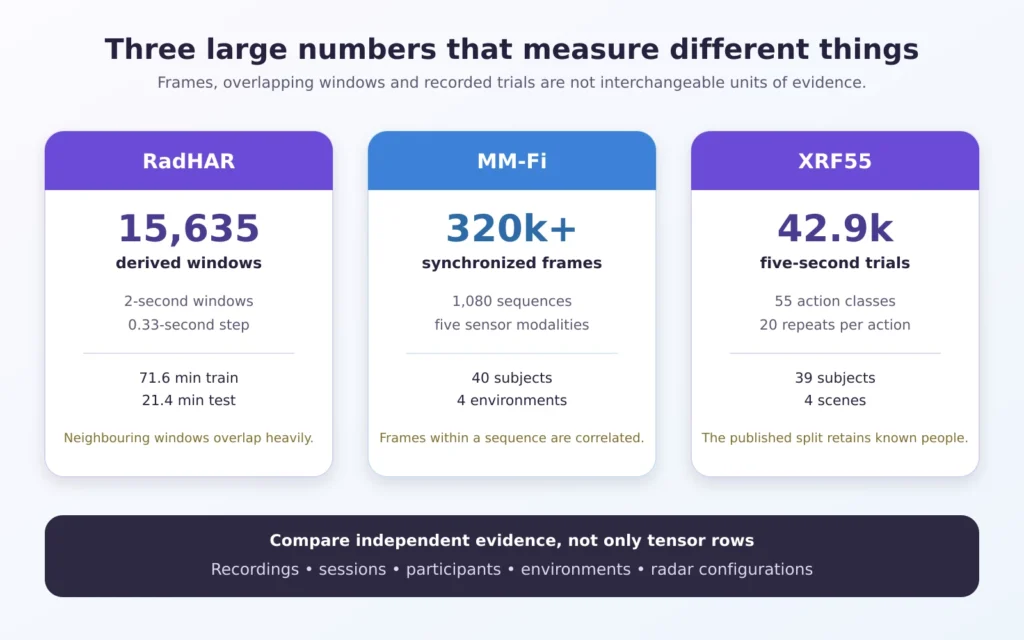
- A frame is one time sample from a sequence; neighbouring frames usually share the same person, room, action, and background.
- A sliding window may share most of its samples with the next window. RadHAR’s 2-second windows advance by 0.33 seconds, so adjacent windows overlap by about 83.5%.
- A trial is more independent than a frame but can still share the same participant, session, position, clothing, room, and radar configuration with other trials.
- A participant, session, environment, or device is the unit that matters when the claim concerns generalization across that factor.
A more defensible dataset summary reports at least five counts: original recordings, participants, sessions, environments, and radar configurations. Derived frames and windows are then reported separately. This prevents preprocessing from inflating the apparent amount of independent evidence.
The split must match the sentence in your abstract
| Claim you want to make | Minimum held-out unit | A split that is not enough |
|---|---|---|
| Recognizes new clips from known users | Recording or session | Random overlapping windows |
| Generalizes to unseen people | Participant | Different trials from the same people |
| Generalizes to a new room | Environment, ideally with subject effects separated | Random clips from every room |
| Generalizes across viewpoint | Radar orientation or aspect angle | New repetitions at the same angle |
| Transfers to another radar | Device or acquisition configuration | Another session on the same hardware |
| Works in continuous monitoring | Uncut streams with background and transitions | Balanced, pre-segmented action clips only |
| Supports clinical use | Relevant patient cohort and deployment setting | Healthy volunteers performing guided simulations |
Two subtleties deserve special attention. First, XRF55’s published first-14-versus-last-six trial split retains the same people in both partitions. That is valid for repeatability on known users, but it does not test unseen users. Second, MM-Fi allocates a distinct ten-person group to each environment. Its cross-environment protocol is useful as a combined domain shift, but participant and environment effects are coupled. This is an inference from the documented collection design, not a criticism of the release.
The safest rule is to assign complete groups to train, validation, and test partitions before windowing, augmentation, normalization, or frame aggregation. Our end-to-end radar-HAR pipeline guide gives the practical reason: once overlapping examples from one parent recording cross a boundary, a classifier can learn recording-specific shortcuts.
A two-stage selection method you can defend
Stage 1: apply hard gates
Reject a dataset immediately if it fails any requirement that is essential to the study:
- Task gate: the labels describe the event you actually need, including background, transitions, falls, gestures, or rehabilitation movements where relevant.
- Signal-level gate: the release contains data early enough in the chain for the proposed contribution.
- Evaluation gate: participant, session, room, viewpoint, and device identifiers needed for the claimed split are available.
- Access gate: the required files can actually be downloaded, opened, and understood now.
- Licence gate: the data terms permit the planned research, redistribution, model release, or commercial activity.
- Resource gate: storage, memory, preprocessing time, and compute fit the project.
Stage 2: score preferences, not necessities
After the hard gates, score each remaining dataset from 0 to 5 on participant diversity, environment diversity, annotation quality, documentation, baseline code, representation flexibility, download burden, and similarity to deployment. Give each criterion a project-specific weight. A useful weighted score is simply the sum of each rating multiplied by its weight, divided by the sum of the weights.
Do not let a high total override a failed gate. A perfectly documented point-cloud dataset still cannot validate a new ADC calibration algorithm. Likewise, a research-only licence cannot be “outscored” if the intended use is commercial.
Run this one-hour audit before training
- Read the paper, repository README, and licence separately. A code licence does not automatically license the dataset, and an open-access paper does not automatically grant data reuse.
- Download one real sample. Confirm that the advertised link works, the archive extracts, and the fields match the documentation.
- Identify the earliest released signal. Inspect its shape, dtype, units, axes, timestamps, and whether values are complex.
- Trace one label. Determine whether it came from a scripted filename, manual video annotation, skeleton motion, wearable tag, or another source.
- Draw the independence tree. Map every frame or window to its parent recording, session, person, room, viewpoint, and device.
- Reproduce one official visualization. A physically sensible range, velocity, point cloud, or spectrogram is a stronger loader test than a successful tensor printout.
- Recreate the official split. Check that no parent group appears in more than one partition and state exactly what the split measures.
- Estimate the full cost. Include archive expansion, cached representations, checkpoints, multiple folds, and repeated seeds—not only download size.
Specialized datasets worth knowing
FAU multistatic radar-network dataset
The FAU release stores two four-dimensional radar cubes per measurement for 15 participants and accompanies a 2024 study of a millimetre-wave MIMO radar network for activity recognition and fall detection. The archive is about 62 GB and is listed as CC BY-NC. It is a better match than point-cloud datasets when spatial diversity across two radar views is central to the method.
mmGait10 for open-set identity and gait
mmGait10 provides about five hours of 77–81 GHz sparse point clouds from ten people walking freely, walking while holding a smartphone, and walking with hands in pockets. Its one-minute sequences and open-set-gait focus make it useful for identity rejection and gait robustness, but it is not a general multi-activity benchmark.
MMVR for indoor radar perception rather than clip-level HAR
The MMVR dataset contains 345,000 multi-view radar frames from 25 people across six rooms, with bounding boxes, segmentation instances, and millions of keypoints. It is valuable for detection, pose, and segmentation in the image plane. Choose it when those perception tasks are the target; do not count it as a drop-in activity-classification dataset merely because people move in the recordings.
Common dataset-selection mistakes
- Choosing by sample count. Ten thousand overlapping windows may contain less independent variation than a few hundred recordings across new people and rooms.
- Calling every early folder “raw.” Point clouds, spectrograms, and radar cubes have already passed through different irreversible operations.
- Using the official split without reading its claim. A supplied split is reproducible, but it may test known users rather than unseen users.
- Splitting after windowing. Overlapping children of one recording can leak across train and test sets.
- Confounding person and room. If different people appear in each room, a “cross-room” result also includes subject shift.
- Ignoring absent classes. A clip classifier trained without background, transitions, and unknown actions is not yet a continuous monitor.
- Treating a healthy-volunteer benchmark as clinical evidence. Simulated falls or guided rehabilitation motions answer a narrower question.
- Assuming the paper licence covers every file. Check the dataset record and code repository independently.
- Building around a link before testing it. Large research datasets are sometimes moved, restricted, split across hosts, or temporarily unavailable.
What we would choose for a new radar-HAR study
For a conventional graduate project, we would use a staged design rather than searching for one perfect corpus:
- Prove the loader and model on a tractable release. RadHAR is suitable for point clouds; DopNET is suitable for a narrow Doppler–time exercise.
- Move to the dataset that matches the scientific claim. Use Glasgow for FMCW/ADL processing, CI4R for cross-frequency transfer, OPERAnet for multimodal RF streams, or MM-Fi and Spatial mmWave 2026 for pose and rehabilitation.
- Report the official protocol and one claim-aligned protocol. Preserve comparability with prior work while adding a subject-, room-, or device-exclusive evaluation where metadata permits.
- Collect a small external test set in the intended deployment conditions. A public benchmark can support method development, but a different room, radar placement, population, and background are the real test of transfer.
This strategy is less glamorous than choosing the largest headline number, but it produces a much clearer paper. The public dataset establishes reproducibility; the claim-aligned split tests the intended form of generalization; and the external set reveals whether the system survives outside the benchmark.
Key takeaways
- There is no universally best radar-HAR dataset; the best choice depends on the research claim.
- Signal level is a hard constraint: ADC data, radar cubes, spectrograms, and point clouds support different contributions.
- Glasgow is a strong all-round choice for complex FMCW daily-activity data, while RadHAR is the easiest point-cloud starting point.
- CI4R-MULTI3 is designed for cross-frequency questions; OPERAnet, MM-Fi, and XRF55 support different forms of multimodal research.
- The 2026 Spatial mmWave dataset is especially useful for controlled health and rehabilitation studies with skeleton supervision, but it is not clinical validation.
- Frames and overlapping windows are not independent samples. Report recordings, sessions, people, rooms, and devices separately.
- Use participant-, environment-, or device-exclusive splits only when they match the sentence you intend to write in the abstract.
- Verify access and licensing with a real download before building a project around any dataset.
References and official dataset pages
- A. D. Singh, S. S. Sandha, L. Garcia, and M. Srivastava, “RadHAR: Human Activity Recognition from Point Clouds Generated through a Millimeter-Wave Radar,” ACM mmNets, 2019; official repository and data.
- F. Fioranelli et al., “Radar Signatures of Human Activities,” University of Glasgow research dataset, 2019.
- M. Ritchie, R. Capraru, and F. Fioranelli, “Dop-NET: A Micro-Doppler Radar Data Challenge,” Electronics Letters, 2020; official repository.
- S. Z. Gürbüz, M. M. Rahman, E. Kurtoğlu, T. Macks, and F. Fioranelli, “Cross-Frequency Training with Adversarial Learning for Radar Micro-Doppler Signature Classification,” SPIE, 2020; CI4R-MULTI3 repository.
- M. J. Bocus et al., “OPERAnet, a Multimodal Activity Recognition Dataset Acquired from Radio Frequency and Vision-Based Sensors,” Scientific Data, 2022; official data collection.
- J. Yang et al., “MM-Fi: Multi-Modal Non-Intrusive 4D Human Dataset for Versatile Wireless Sensing,” NeurIPS Datasets and Benchmarks, 2023; official toolbox.
- F. Wang, Y. Lv, M. Zhu, H. Ding, and J. Han, “XRF55: A Radio Frequency Dataset for Human Indoor Action Analysis,” Proceedings of the ACM on Interactive, Mobile, Wearable and Ubiquitous Technologies, 2024; official project page.
- K. Guo, E. Dogu, and K. Z. Rajab, “A Spatial Millimetre-Wave Radar Point Cloud Dataset for Health Applications,” Scientific Data, 2026; data record.
- A.-C. Fröhlich et al., “A Millimeter-Wave MIMO Radar Network for Human Activity Recognition and Fall Detection,” IEEE Radar Conference, 2024; official dataset.
- R. Mazzieri, J. Pegoraro, and M. Rossi, “mmGait10: Open-Set Gait Recognition from Sparse mmWave Radar Point Clouds,” Zenodo dataset, 2025.
- M. M. Rahman et al., “Millimeter-Wave Multi-View Radar (MMVR) Dataset,” Zenodo dataset and ECCV benchmark, 2024.