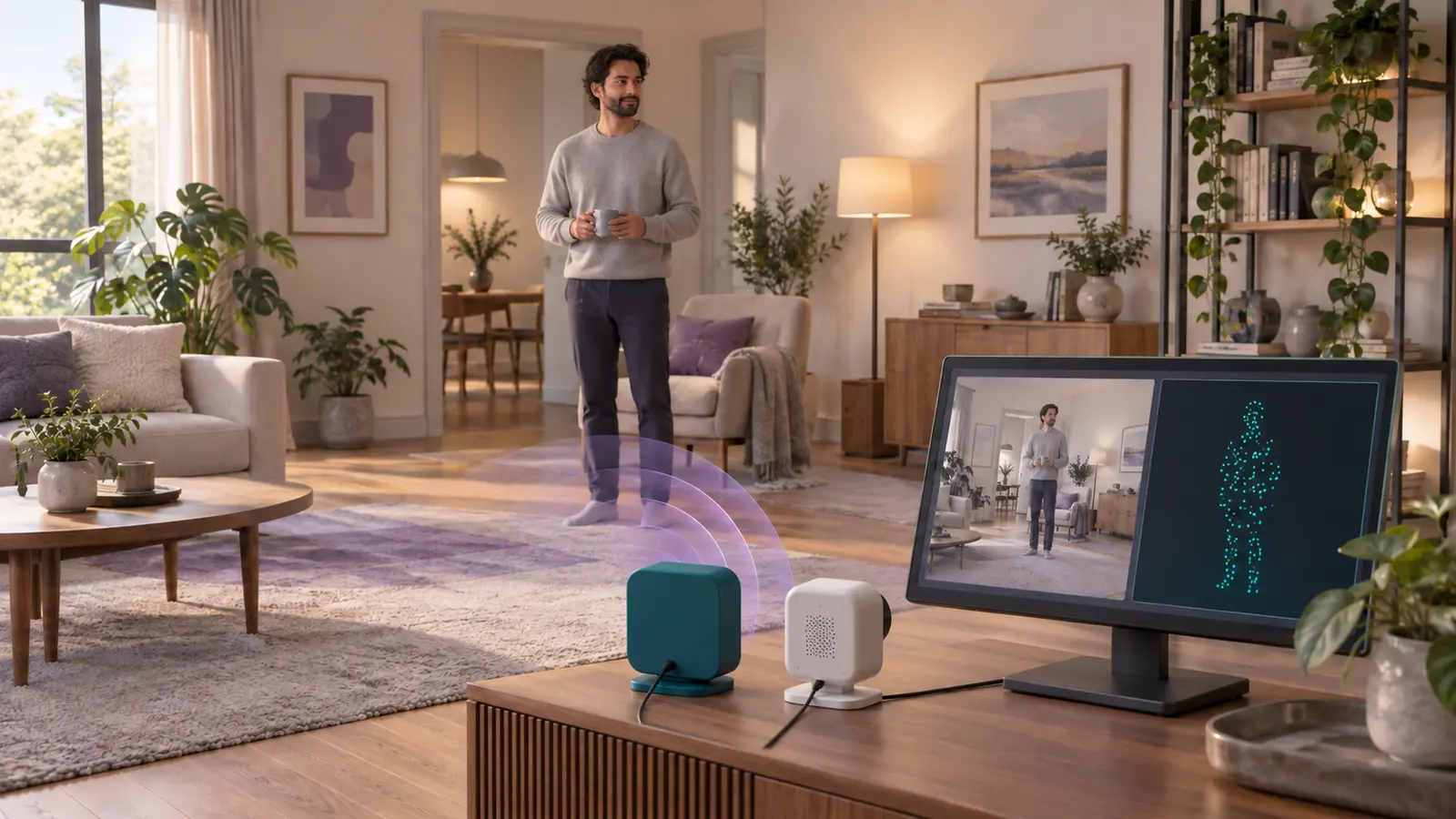
Radar can replace cameras when the required output is a validated measurement of presence, movement or a specific physiological motion, and a visual record is unnecessary. It is less suitable when monitoring requires appearance, object context or detailed visual verification. The decision depends on the task, room, people and acceptable errors. Neither sensor is automatically private, reliable or clinically suitable simply because of how it senses.
Consider a person getting up from a chair. An occupancy system needs to know whether someone remains in the room. An activity monitor needs to distinguish standing from walking. A care workflow may need to establish whether a fall occurred and whether assistance is required. These are different questions, even though they begin with the same movement.
This guide compares radar and cameras for indoor human monitoring. It examines what each sensor measures, what selected primary studies actually demonstrate, and how to test a replacement claim. It is a practical evidence synthesis, not a systematic review or a ranking of commercial products.
Start with the monitoring question
Human monitoring describes a family of tasks. Before choosing hardware, specify the output that someone will act on. Our introduction to radar-based human activity recognition explains why detecting a person, classifying an activity and estimating a pose need different evidence.
| Required output | Reasonable starting point | What the deployment must prove |
|---|---|---|
| Room occupancy or zone presence | Radar is a strong candidate when images add little value. | Reliable detection of quiet occupants, correct zone boundaries and recovery after a missed detection. |
| Walking, sitting or other defined activities | Evaluate radar and vision on the same target activities. | Performance on new people, rooms, viewpoints and unplanned movements. |
| Detailed pose or interaction with objects | RGB or depth imaging is often a useful starting point. | Joint or action accuracy under relevant occlusion, lighting and object conditions. |
| A possible fall requiring follow-up | Radar, vision or a combined system may be appropriate. | Event sensitivity, false alerts per monitored time, latency and a workable response process. |
| Respiratory motion during rest | A purpose-built radar system is a candidate. | Agreement with a suitable reference, usable measurement coverage and explicit handling of movement. |
| Visual explanation of what happened | A camera provides information that a motion-only radar output does not preserve. | An appropriate field of view and a justified policy for access, storage and review. |
These starting points are engineering judgments, not universal performance rankings. A presence detector that works in one meeting room may still fail beside a moving curtain, behind furniture or after its mounting angle changes.
Radar and cameras observe different evidence
An RGB camera records light intensity and colour across an image. Those pixels can preserve clothing, objects, body outlines and scene context. A model can use that information to infer a pose or activity, but the interpretation remains an estimate.
An FMCW radar transmits a waveform and processes its echoes. With suitable bandwidth, antennas and processing, it can estimate range, direction and radial velocity; phase changes can also reveal small movements. Its output may be complex samples, a radar map, a point cloud or tracks. A point is a detected reflection, not necessarily a human joint. TI people-tracking reference design [1].
A radar-generated skeleton therefore requires an inference step. It should not be read as a direct anatomical measurement. Similarly, a camera-generated skeleton can contain inferred joints that were not clearly visible. Compare the final measurements against an independent reference, rather than treating an attractive overlay as validation.
For the signal-processing details, see how FMCW radar produces range–Doppler–angle maps.
A fair comparison must name the camera
A conventional RGB camera depends on suitable illumination. That does not mean every camera stops working when the room lights go out. Active infrared depth cameras provide their own illumination: Microsoft’s documented time-of-flight design projects modulated near-infrared light and estimates depth from the returning signal. Its documentation also describes invalid depth measurements caused by weak signals, saturation and multipath. Microsoft depth-camera documentation [2].
Compare radar with the optical system you would actually deploy, including any infrared illumination or depth sensing. A test against an unilluminated RGB camera answers a narrower question than a test against a properly configured night-time monitoring system.
What the research demonstrates—and where the evidence stops
Three studies illustrate different levels of evidence. Their metrics answer different questions and should not be combined into a single “radar accuracy” score.
| Study and task | Demonstrated result | Boundary of the evidence |
|---|---|---|
| RF-Pose, 2018: 2D pose [3] | Reported pose average precision of 62.4 in visible scenes, compared with 68.8 for its vision teacher, and 58.1 through walls. | A particular research radio, model and evaluation. It used visual supervision during training. This is neither activity-classification accuracy nor a guarantee for an arbitrary mmWave sensor. |
| mmFall, 2020 preprint: falls [4] | Reported detection of 49 of 50 performed falls, with two false alarms in its evaluation. | The two participating authors had similar builds; the apartment was relatively empty. The result does not establish a false-alert rate for months of use by a diverse care population. |
| Toften et al., 2024: respiratory rate [5] | Monitored 32 resting hospital patients for a median of 42 minutes. For the stationary configuration, bias was 0.1 breaths/min and 95% limits of agreement were −1.1 to 1.2 breaths/min. | Evidence for one system and resting-patient protocol. It does not validate unrestricted activity monitoring. Manufacturer employment and share ownership were disclosed for several authors. |
The practical lesson is to carry the study conditions with the result. A successful demonstration can justify a pilot. Replacing an existing monitoring system requires evidence for the people, conditions and consequences of that deployment.
A benchmark trap: training can change the apparent winner
MM-Fi provides a useful example. For 3D pose estimation under its all-action protocol P3 and random split S1, the paper reports the following mean per-joint position error (MPJPE). Lower values are better. MM-Fi, Tables 3 and 9 [6].
| Input and training | MPJPE (mm) | Reported standard deviation (mm) |
|---|---|---|
| RGB; externally pretrained model | 279.0 | Not reported in this row |
| mmWave radar; trained on MM-Fi | 117.0 | 3.7 |
| RGB; trained on MM-Fi | 60.5 | 0.4 |
The first two rows appear to favour radar. The paper’s additional RGB training changes that conclusion. The systems still differ in architecture, representation and temporal input, so these numbers are not a hardware-only comparison.
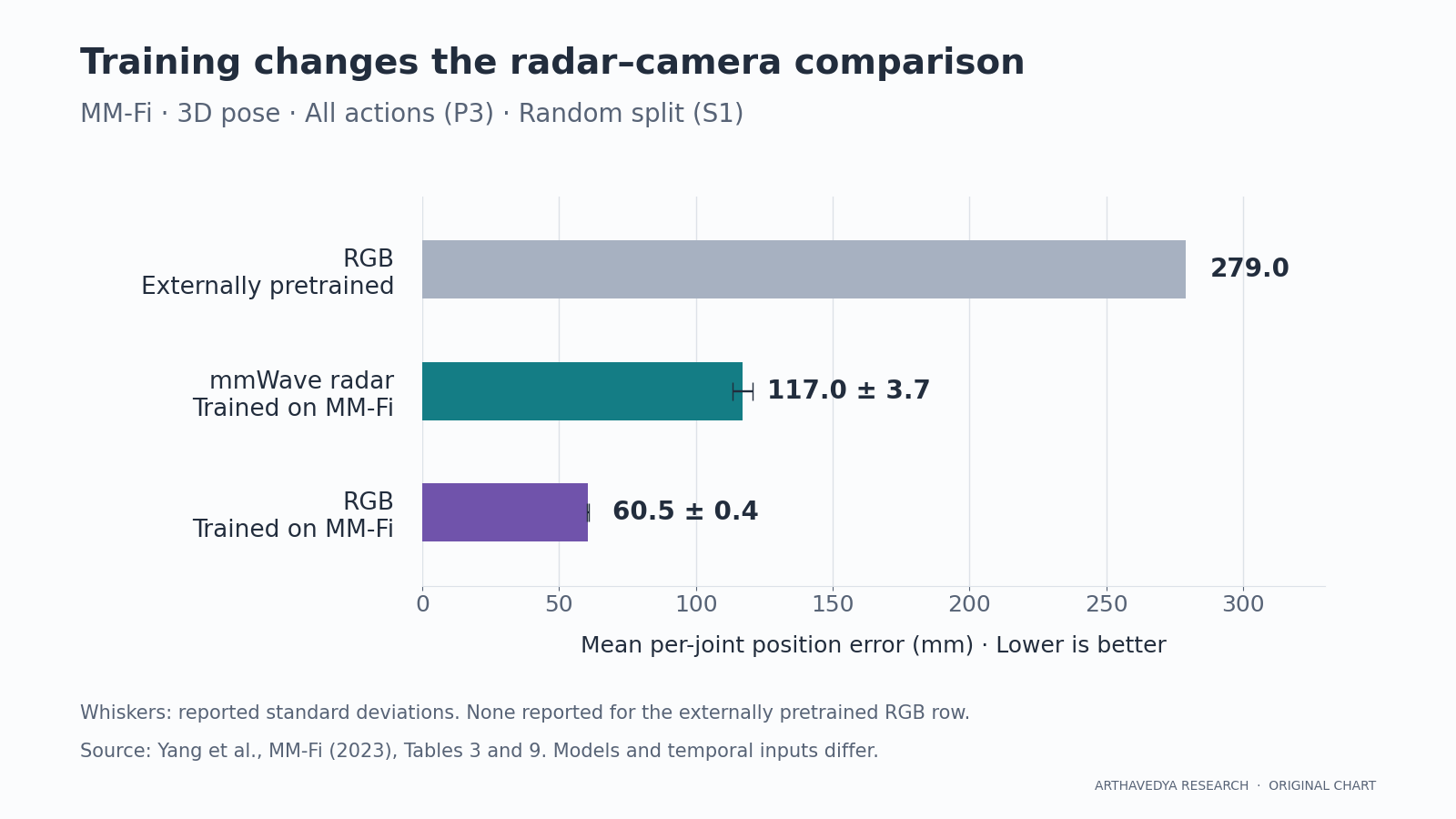
A useful evaluation report should therefore describe training data, adaptation, model capacity and the amount of time each prediction observes. “Same dataset” alone does not guarantee a fair comparison. Our radar-HAR dataset comparison helps identify datasets and evaluation splits suited to a particular research claim.
Where radar can make a convincing replacement case
Presence and movement without a visual record
When the output is “occupied,” “empty” or “someone entered this zone,” a detailed image may be unnecessary. Radar processing can support people tracking and counting; TI’s reference design is a concrete implementation example. TI people-tracking reference design [1].
Presence and movement are not interchangeable. A pipeline that aggressively removes stationary returns may suppress the evidence needed to retain a quiet occupant. Test someone reading, resting or standing still for the actual timeout period. Also test a person who stops near the edge of a zone. An empty output must not silently become proof of an empty room.
Motion features that do not depend on room lighting
Radar’s measurement does not require visible illumination, making it useful when lighting changes are part of normal operation. Nevertheless, geometry still matters: Doppler measures motion toward or away from the sensor. Motion across its view can produce different features from motion along its line of sight.
A classifier trained mostly on people approaching the sensor may struggle with people moving sideways. Our micro-Doppler guide explains how viewing direction affects human motion signatures. Include the intended approach angles in the experiment rather than assuming a model will learn the missing geometry.
Selected contactless physiological measurements
Radar can sense chest motion associated with respiration, and suitable processing can estimate a breathing rate. Gross movement, the selected reflection and separation between people all affect the signal-processing problem. TI’s vital-sign application note describes the measurement approach. TI vital-sign sensing application note [7].
The hospital study above is valuable because it compares a particular respiratory-rate output against a reference in patients. Its protocol involved rest, and monitoring paused during examinations. That distinction matters when someone proposes extending the result to a freely moving person. hospital respiratory-rate study [5].
Cameras can also estimate physiological signals. Verkruysse and colleagues demonstrated remote plethysmography using ambient light and a consumer camera. The defensible comparison concerns the required measurement, usable conditions and validation—not an assumption that only radar can detect physiology. camera-based plethysmography study [8].
A respiratory waveform alone does not establish diagnostic performance. Evaluate the exact intended output, including how the system flags an unreliable measurement and how much monitored time remains usable.
Where camera replacement remains difficult
Appearance and the reason behind an action
A person bends toward the floor. They might be picking up a dropped object, tying a shoe or losing balance. Radar can provide motion evidence, and a trained model may distinguish some of these cases. A camera can also preserve the object and surrounding visual context.
If the requirement includes reading an object label, checking a hand–tool interaction or visually reviewing an incident, a radar motion estimate does not provide equivalent evidence. Define which information may be discarded before calling the replacement successful.
Occlusion is a material and geometry problem
RF-Pose demonstrates that radio sensing can recover pose through some obstructions, but its authors also identify occlusion between people as a limitation. An RF result does not establish that every wall, person or furniture arrangement is transparent to every radar. RF-Pose study [3].
Treat through-wall performance as a measured property of a particular frequency, material, geometry and link budget. Do not transfer it automatically to a 60 or 77 GHz board. The 24, 60 and 77 GHz radar comparison explains why carrier frequency alone is an incomplete purchasing specification.
Crowds and persistent identity
Distinguishing two people is harder than detecting that at least one person is present. Test crossing paths, close spacing, a person standing behind another, and one person leaving while someone else stays. Score track swaps and lost tracks, not just the number of detections.
A track identifier such as “person 3” is a temporary association created by the software. It does not automatically establish who the person is, or whether a newly created track corresponds to somebody seen earlier. Persistent identification is a separate requirement with separate privacy implications.
Privacy depends on what the system retains and infers
Avoiding recognisable video can reduce exposure of faces, clothing and domestic surroundings. It does not make radar data anonymous. RF-Pose demonstrated 83.4% identification accuracy among 100 enrolled people from walking-derived skeletons in visible scenes. This was recognition among known identities, not unrestricted identification of strangers. RF-Pose study [3].
Location histories, routines and inferred activities can also be sensitive. A privacy assessment should cover the complete data path: raw measurements, derived features, stored events, access rights and deletion. It should also include training data; a radar-only deployment may have been developed using synchronised video.
For a particular application, define the minimum information needed to support the decision. An occupancy bit retained briefly has a different exposure from months of identifiable video, but also from months of detailed movement trajectories. Processing locally and keeping only necessary outputs can reduce retained information with either sensor. That is a design choice, not an automatic property of the sensor label.
Why 99% accuracy can still produce mostly false positives
Continuous monitoring often contains many more ordinary moments than target events. Consider an illustrative classifier evaluated on 10,000 fixed decision windows: 10 contain the target condition and 9,990 do not. Assume 95% sensitivity, meaning it detects 95% of positive windows. This is an arithmetic example, not a measured fall prevalence or a claimed product result.
At 99% specificity, the classifier correctly rejects 99% of negative windows. It therefore produces an expected 9.5 true-positive windows and 99.9 false-positive windows. Only about 8.7% of its positive predictions are correct, although its overall accuracy rounds to 99.0%. Fractional counts describe expected averages, not partial events.
| Specificity | Expected false-positive windows | Precision: positive predictions that are correct |
|---|---|---|
| 99% | 99.9 | 8.7% |
| 99.9% | 9.99 | 48.7% |
| 99.99% | 0.999 | 90.5% |
Every row assumes the same 10 positive windows, 9,990 negative windows and 95% sensitivity. Each therefore has 9.5 expected true-positive windows. Precision is the true-positive count divided by all positive predictions. The changing denominator explains the large difference between the rows.
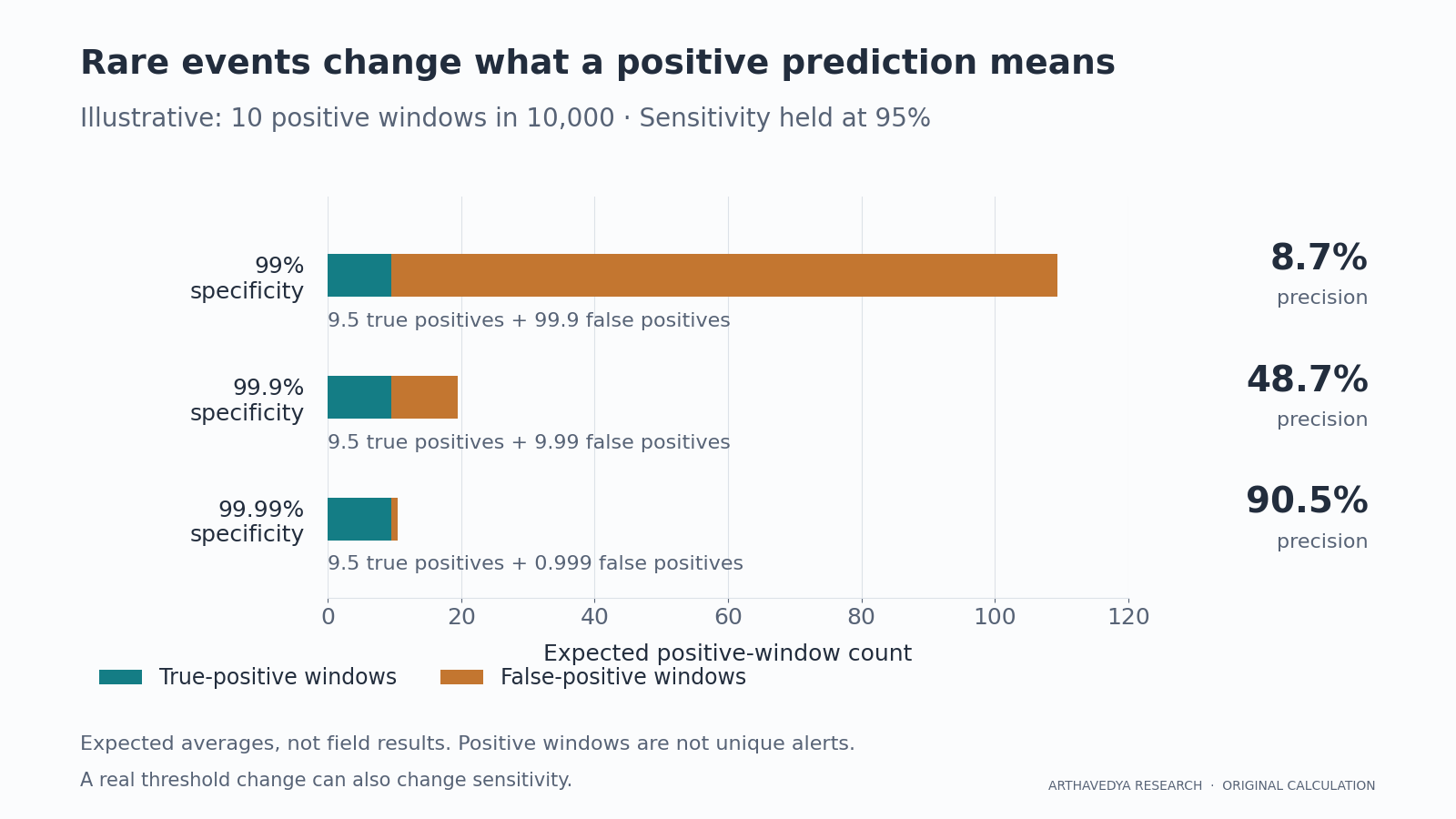
Changing a real detection threshold usually changes sensitivity as well as specificity. The table isolates one effect; it does not claim that a system can improve specificity while keeping every other property fixed.
Adjacent positive windows may belong to one event. Persistence rules, overlapping windows, tracking and alert suppression change how predictions become notifications. For deployment, measure false alerts per room-day or monitored hour, event sensitivity and detection latency after that complete logic runs. Window-level specificity cannot be converted into a daily alert rate without a timing and event-grouping model.
How to run a fair radar-versus-camera pilot
The following protocol is an ArthaVedya engineering recommendation. It applies whether the initial preference is radar, vision or a combination.
- Define the decision and unit of evaluation. Specify whether you are scoring windows, people, tracks, falls or intervals of usable respiratory-rate output. Write down the consequences of a miss and a false alert.
- Record matched conditions. Observe the same sessions with both sensors, synchronise timestamps and document any difference in field of view. Evaluate the coverage you intend to install, not merely the area both sensors happen to see well.
- Give both systems a credible configuration. Use the required camera illumination and radar settings. Report training data, adaptation, temporal context, compute and latency. Do not pair a carefully adapted model with an unrelated pretrained baseline and attribute the difference solely to sensing physics.
- Separate development from the final test. Hold out people, sessions or rooms according to the deployment claim. Keep overlapping windows from a recording together. Freeze thresholds and alert rules before evaluating the held-out data.
- Use a suitable reference and record uncertainty. Manually verify ambiguous events or use an appropriate measurement reference. If a vision model provides radar training labels, do not use those same unchecked predictions as the only final proof of accuracy.
- Include ordinary operation and failure cases. Test quiet occupants, visitors, multiple people, rearranged furniture, changed lighting, cleaning activity, blocked views, network loss and sensor restarts. Keep invalid or missing outputs in the report.
For the collection and split design, follow the radar-HAR dataset collection guide. More windows from the same easy recording do not substitute for new people and conditions.
| Task | Useful measurements | Common reporting mistake |
|---|---|---|
| Presence and counting | Missed-occupancy duration, count error and recovery time. | Counting only moments when someone is visibly moving. |
| Activity or fall events | Per-class recall, event sensitivity, false alerts per monitored time and latency. | Reporting balanced clip accuracy as evidence for continuous operation. |
| Pose and tracking | Joint error with the alignment convention stated; track loss and identity switches. | Reporting error only on successfully tracked frames. |
| Respiratory rate | Bias, limits of agreement and the fraction and duration of valid measurements. | Reporting low error after removing all difficult intervals without disclosing the missing time. |
Report how uncertainty was calculated. Thousands of correlated frames from one person are not thousands of independent participants. A pilot also needs enough relevant observation time to make its false-alert estimate useful; a short run with no alerts is weak evidence for a rare failure.
Choose the architecture after the evidence
Use radar alone when the required measurements have passed the relevant tests and visual information adds insufficient value to justify collecting it. Examples may include occupancy or a narrowly defined motion-monitoring task. Retain an explicit “unknown” or “measurement unavailable” state.
Use a camera with limited retention when appearance or scene context is essential. Consider whether local processing can deliver the required output without routine video storage. Test the actual illumination, viewing angle and obscuration conditions.
Combine sensors when a pilot demonstrates a useful reduction in consequential errors. Radar might provide persistent motion evidence while vision helps resolve an ambiguous interaction. The combination still needs calibration, synchronisation, maintenance and a policy for occasions when the sensors disagree.
Fusion is not automatically a reliability upgrade. Requiring both sensors to agree can miss events when one view is blocked; allowing either sensor to trigger can increase false alerts. A camera activated only after a radar alert also cannot recover an event that radar never detected. Test the complete decision rule, including loss of either input.
Compare total operational cost: hardware, installation, coverage, compute, annotation, storage, maintenance and time spent reviewing alerts. A lower sensor price is not a lower-cost system if it creates more work downstream.
Key takeaways
- Replace a defined function. “Human monitoring” is too broad to validate as one capability.
- Read the experimental conditions with the score. Training, population, room, reference and metric can change the interpretation.
- Measure what the deployment experiences. Include quiet periods, missing outputs, false alerts and response latency.
- Minimise information deliberately. Radar reduces some visual exposure, but neither sensing modality guarantees privacy.
- Let the pilot determine the architecture. Choose radar, cameras or fusion according to the required evidence and acceptable errors.
References
- Texas Instruments. People Tracking and Counting Reference Design Using mmWave Radar Sensor. TIDUE71D, revision D. Manufacturer implementation documentation. [1]
- Microsoft. Azure Kinect DK depth camera. Official technical documentation on active infrared time-of-flight sensing and invalid depth measurements. [2]
- Zhao, M., et al. Through-Wall Human Pose Estimation Using Radio Signals. CVPR, 2018. See the pose evaluation, identification experiment and scope limitations. [3]
- Jin, F., Sengupta, A., and Cao, S. mmFall: Fall Detection using 4D MmWave Radar and a Hybrid Variational RNN AutoEncoder. arXiv:2003.02386, version 4, 2020. See experimental setup, data collection and limitations. [4]
- Toften, S., et al. Contactless and continuous monitoring of respiratory rate in a hospital ward: a clinical validation study. Frontiers in Physiology, 15, 1502413, 2024. DOI: 10.3389/fphys.2024.1502413. [5]
- Yang, J., et al. MM-Fi: Multi-Modal Non-Intrusive 4D Human Dataset for Versatile Wireless Sensing. NeurIPS Datasets and Benchmarks, 2023; linked author version: arXiv:2305.10345v2. Figure 1 uses Tables 3 and 9, protocol P3, split S1. [6]
- Peake, G., and Chevrier, M. Building a multipatient contactless vital signs sensor for at-home use with mmWave radar sensors. Texas Instruments, SLYT836. Manufacturer application note. [7]
- Verkruysse, W., Svaasand, L. O., and Nelson, J. S. Remote plethysmographic imaging using ambient light. Optics Express, 16(26), 21434–21445, 2008. DOI: 10.1364/OE.16.021434. [8]